The Shopping Trip Nobody Admits To
Most of us picture burglary as a heist: a planned job, a dark figure, a safe behind a painting. The reality looks more like shopping. Someone with an urgent need, usually cash and often drugs, moves through a neighborhood comparing houses the way you compare checkout lines. Which one is fastest? Which one is least likely to cause trouble?
We know this partly because researchers asked. A team at the University of North Carolina at Charlotte, led by criminologist Joseph Kuhns with Kristie Blevins and Seungmug Lee, surveyed 422 incarcerated burglars chosen at random from prisons in North Carolina, Kentucky, and Ohio. Their final report, Understanding Decisions to Burglarize from the Offender’s Perspective, is dated December 2012, and the university publicized the findings in May 2013.
Two caveats belong up front. The Alarm Industry Research and Educational Foundation, an industry group, paid for the study, so the funder had a stake in the answers. And these are self-reports from people in prison, which tells you what burglars say they do rather than what a camera saw them do. Even so, the answers fit common sense and federal crime data, and they are about as close as anyone gets to interviewing the competition.
The respondents were not specialists in one kind of target, either. About half said they had committed residential burglaries, and 31 percent said they had broken into commercial properties. The same people who try a back door on a cul-de-sac may try a storeroom door behind a strip center the next week, which is why the habits described below apply to a home office or a small shop as much as to a three-bedroom house in the suburbs.
Most Break-Ins Aren’t Planned, and That Changes Everything
The most useful finding is also the least cinematic. Only about 12 percent of the burglars said they typically planned the burglary. Forty-one percent said it was most often a spur-of-the-moment decision, and 37 percent said it varied. The careful casing operation exists, but it is the exception.
Motive explains the hurry. Asked for their top reason, 51 percent of respondents pointed to drugs and 37 percent to money, which often went to drugs as well. A person working on that kind of deadline is not hunting for the richest house on the street. He wants the one he can get into and out of quickly, with the least chance of an audience.
That is good news, because easy is something you control. You can’t make your house less valuable, and you shouldn’t try. You can make it look slower, louder, and more likely to end badly than the house next door. A burglar choosing in seconds responds to signals, not to your net worth.
A burglar choosing in seconds responds to signals, not to your net worth.
What the Alarm Question Revealed
The survey asked about alarms directly, and the answers were blunt. About 83 percent said they would try to find out whether a home had an alarm before attempting a break-in. Roughly 60 percent said an alarm would lead them to look for a different target.
The follow-up question was what happens when a burglar discovers an alarm partway through. Half said they would stop the attempt. Another 31 percent said they would sometimes back off. Only 13 percent said they would always keep going. A siren does not stop everyone, but it shortens the visit, and short visits mean smaller losses.
Notice what those numbers reward: being seen. A burglar who checks for an alarm is reading yard signs, window decals, a keypad glimpsed through the glass, and the camera over the porch. A monitored home security system works twice, first as a signal at the curb, then as a siren and a call to the 24/7 monitoring center if someone tests it anyway.
Cameras Registered Too, Just Not as Loudly
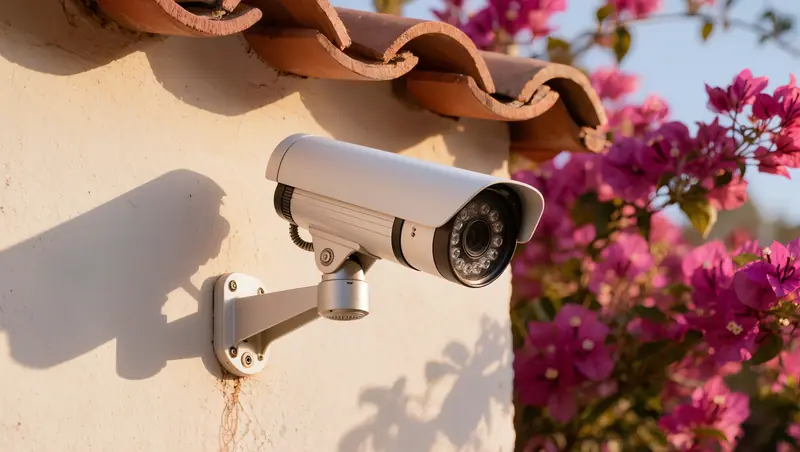
Cameras mattered to the respondents, though less than alarms did. Nearly 60 percent said they would consider whether cameras or other surveillance equipment were present when picking a target, and more than 40 percent said that would push them toward another house.
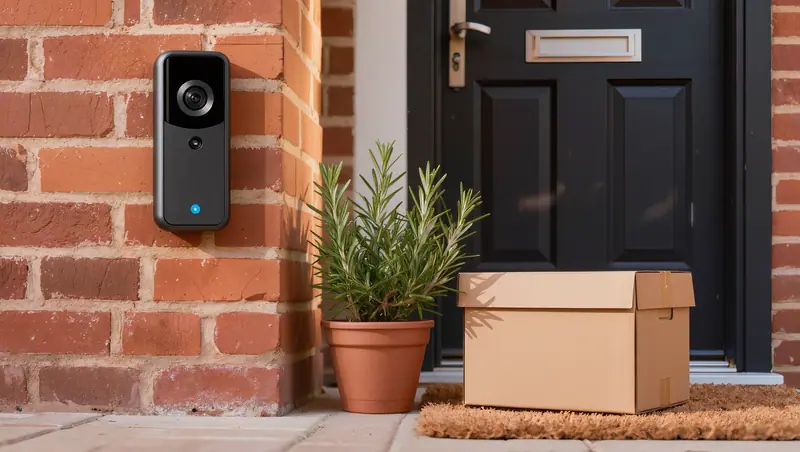
The gap makes sense from the burglar’s side of the fence. An alarm changes what happens in the next three minutes. A camera mostly changes what happens next month, when a detective is reviewing footage. Someone in a hurry discounts the future. That is why the camera setups that deter best do something right now: a security camera that switches on floodlights or plays a spoken warning, or a doorbell camera that lets you answer the door from your desk at work.
Placement matters as much as presence. One camera that captures a face at the side gate is worth more than three that capture the street. If you plan to aim one toward a shared fence or a neighbor’s yard, read our plain-English guide to Texas security camera laws before you mount it.
How They Get In: The Door Nobody Locked
FBI data fills in what the survey can’t: how entry actually happens. For 2019, the Bureau estimated 1,117,696 burglaries nationwide, and residential properties accounted for 62.8 percent of them. By method, 55.7 percent involved forcible entry and 6.5 percent were attempted forcible entries.
The remaining 37.8 percent were unlawful entries with no force at all. Translated from bureau language: in more than a third of burglaries, nobody had to break anything. A door was unlocked, a window was open, a garage was left up, or a key was hidden exactly where everyone hides a key.
That category is the cheapest one to shrink. Locking up is a habit, and habits fail on busy mornings. Smart locks that relock themselves after a set time, and a garage door that sends an alert when it stays open, turn a habit into a setting. They also let you confirm from anywhere that the house is actually closed.
- Lock the door between the garage and the house, not just the front door.
- Make sure every sliding door has a working pin lock or a security bar.
- Retire the spare key under the mat, the fake rock, or the flowerpot.
- Close the garage door, and get an alert whenever it stays open.
Empty Houses, and the Times They Aren’t
Federal victimization data adds a sober note. A Bureau of Justice Statistics report on National Crime Victimization Survey data from 2003 through 2007 found an average of about 3.7 million household burglaries a year. A household member was present in roughly 28 percent of them, and household members became victims of violence in about 7 percent of burglaries.
Read the other way, nobody was home in most of those burglaries, which fits an offender who prefers an empty house. The home that looks occupied, with a car in the drive, lights on a schedule, and no boxes stacking up by the door, raises the one question a burglar wants to avoid. Our guide to package theft and porch pirates covers that last detail.
The 28 percent is also why we never treat an alarm as a substitute for judgment. If the system sounds while you are home, the job is to get to a safe room and let the monitoring center and police take it from there. In San Antonio, a properly permitted system with few false alarms gets the better hearing; our alarm permit guide explains the rules.
Walk Your Property Like a Hurried Stranger
Put the research together and you get a short test. Stand at the curb. Can you tell the house has an alarm? Is there a camera covering the front door and the side gate? Could someone reach the back of the house without being seen from the street? Would a driver rolling past guess that nobody is home?
Then walk the perimeter. Count the doors and windows a person could open without breaking anything. Look for ladders left out, unlocked sheds, gates without latches, and shrubs tall enough to hide someone working on a window. Those are the details an unplanned burglar notices, because he isn’t plotting. He’s scanning.
This is exactly what we do on a free security assessment, with a trained eye and no obligation. You’ll come away knowing which signals your house sends today, and which two or three changes would make it the least interesting stop on the block.
Straight answers
Questions readers ask
Do alarm systems really deter burglars?
Do burglars watch a house for days before breaking in?
How do most burglars get into a house?
How often is someone home during a burglary?
Are security cameras as effective as alarms?
Sources & methodology
Figures are the most recent we could verify from the publishers below, checked October 2026. Where an official agency publishes nothing more recent, we say so rather than estimate.
- 1.Through the eyes of a burglar – study provides insights on habits and motivations — UNC Charlotte, 2013
- 2.Researcher Expands Knowledge of What Motivates, Deters Burglars — UNC Charlotte College of Humanities & Earth and Social Sciences, 2013
- 3.Understanding Decisions to Burglarize from the Offender’s Perspective (final report) — UNC Charlotte Department of Criminal Justice and Criminology (PDF hosted at siacinc.org), 2012
- 4.Crime in the United States, 2019: Burglary — FBI Uniform Crime Reporting Program, 2019
- 5.Victimization During Household Burglary (NCJ 227379) — Bureau of Justice Statistics, 2003–2007
- 6.Household members experienced violence in about seven percent of burglaries (press release) — Office of Justice Programs, 2010