The Thief Who Works Your Delivery Window
Consider the modern porch pirate’s business model. No tools. No forced entry. No need to know who lives inside. The tracking notification on your phone tells you a box was delivered at 1:42 p.m., and in a sense it tells him too, because the box is now sitting in plain view on a step that faces the street. His entire job is to walk up, pick it up, and look like he belongs there.
The legislature noticed. For years, a package taken from a Texas doorstep was prosecuted as ordinary theft, graded by the value of what was in it. A thief who lifted a phone case from twenty porches might have faced a series of minor charges, if anyone connected them at all. Lawmakers decided the act of stealing mail and packages deserved its own name and its own penalties.
You may have seen package theft surveys quoting large national numbers. Their methods vary, so we won’t repeat a figure we can’t stand behind. What we can describe precisely is Texas law, and the handful of habits that make your porch a poor place to shop.
House Bill 37 and the Birth of Section 31.20
House Bill 37, passed by the 86th Legislature in 2019, created the criminal offense of mail theft in Section 31.20 of the Texas Penal Code. Its authors included San Antonio state Rep. Ina Minjarez, and the governor signed it into law. It took effect on September 1, 2019.
The key move was the definition. Under the law, mail means a letter, postal card, package, bag, or other sealed article addressed to an individual. That covered items delivered by a common carrier or delivery service and not yet received by the addressee, and items left for a carrier to collect. In plain terms, the box a private delivery van left by your door counts, not just what the letter carrier brings.
The penalties scale with the scope of the theft rather than only the price tag. Taking mail from fewer than 10 addresses is a Class A misdemeanor, which in Texas can mean up to a year in county jail. As the number of addresses climbs, the offense becomes a state jail felony and then a third-degree felony, and the law adds enhancements in certain circumstances, such as when the theft targets identifying information. The thief working one cul-de-sac and the thief working a whole subdivision are no longer treated alike.
The thief working one cul-de-sac and the thief working a whole subdivision are no longer treated alike.
The 2025 Update: In Transit, Checks, and Mailbox Keys
In 2025 the 89th Legislature passed Senate Bill 1281, which amended Section 31.20 and took effect September 1, 2025. The revised definition of mail covers a sealed article delivered by a common carrier or delivery service that is still in transit, or that has been delivered but not yet received by the addressee. That closes a gap for items taken before they ever reach the porch.
The bill also folded checks, money orders, and other financial papers into the definition, and created a new offense for stealing or copying the keys and locks used for mail receptacles. The Texas Bankers Association welcomed the law as a tool against mail-related financial crime, which tells you who has been cleaning up after stolen checks. If you mail checks, the safest mailbox is the one inside a post office.
This is general information, not legal advice. Charging decisions belong to police and prosecutors, and the exact thresholds and enhancements live in the statute text.
A Good Law Is Still an After-the-Fact Remedy
A criminal statute is useful when someone is caught. It does not put the blender back on your step. Package theft is a crime of seconds, and the person doing it has usually walked away before you finish reading the delivery alert.
That is why the practical goal is not to win the case. It is to shrink the window. Every minute a package sits unattended and visible from the street is a minute of opportunity. Every minute you can cut, by changing where it lands or how fast you know about it, lowers the odds.
Think of it in three moves: make the package harder to see, harder to reach, or quicker to retrieve. You rarely need all three. One or two, chosen for how your house actually sits on the street, usually does it.
Read Your Own Porch the Way a Stranger Would
Here is a small experiment. Walk out to the curb in the middle of a weekday, turn around, and look at your front door as if you had never seen it. Can you see the step where packages land? Is there a car in the driveway, or does the house look empty? Is there anything between the sidewalk and the door, like a gate, a hedge, or a long walk, that would make a stranger feel watched on the way up?
Now do the same thing from the driver’s seat of a car rolling slowly past. That is the view that matters, because a porch pirate decides in a few seconds, from the street, whether a box is worth the walk. A package visible from a moving car is an invitation. One tucked behind a planter, inside a screened porch, or around the side of the house usually isn’t.
Then check the timing. If your deliveries tend to arrive while everyone is at work or school, the box sits for hours. Scheduling deliveries for days someone is home, or routing them to a pickup point on your commute, does more than any sign in the window. None of this costs anything except a few minutes of looking at your house with fresh eyes, which is exactly what we do on an assessment.
Changing Where the Box Lands
The cheapest fixes are in the delivery app. Most carriers and large retailers let you leave delivery instructions, choose a pickup point, or hold a package at a store or locker. Put anything valuable on signature required. Ship to your workplace if your employer allows it. If you know you will be away, a neighbor who works from home is a better porch than your porch.
Then look at the house. A box left at the front door of a home with a deep, shaded porch is far less visible from the curb than one on a bare stoop. A lockable package box bolted near the entry helps on houses where packages otherwise sit in full view. Some homeowners go a step further with smart garage door control that lets a driver place a package just inside the garage door while you watch, and closes it behind them.
Apartment communities have their own version of this problem, magnified by volume. Package rooms with access control and cameras covering the door give residents a better answer than a pile in the leasing office. Our multi-family security work often starts there.
- Add delivery instructions asking drivers to place packages out of street view.
- Use pickup points or lockers for anything you can’t afford to lose.
- Require a signature for high-value orders.
- Ask a trusted neighbor to grab deliveries when you travel.
Cameras That Help You Act, Not Just Watch
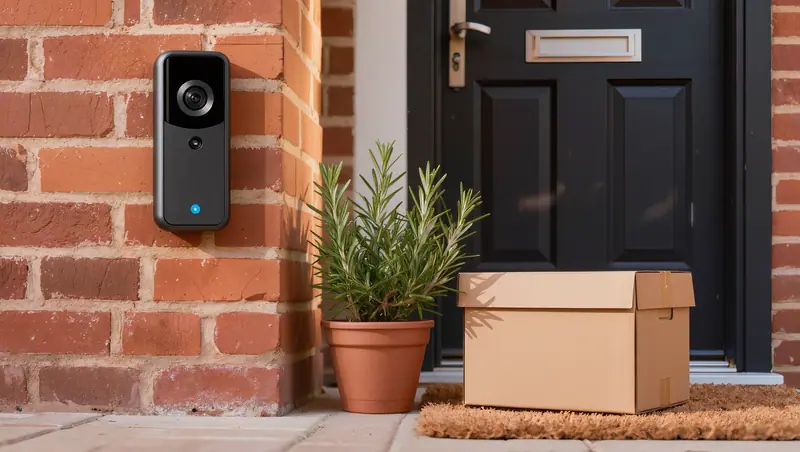
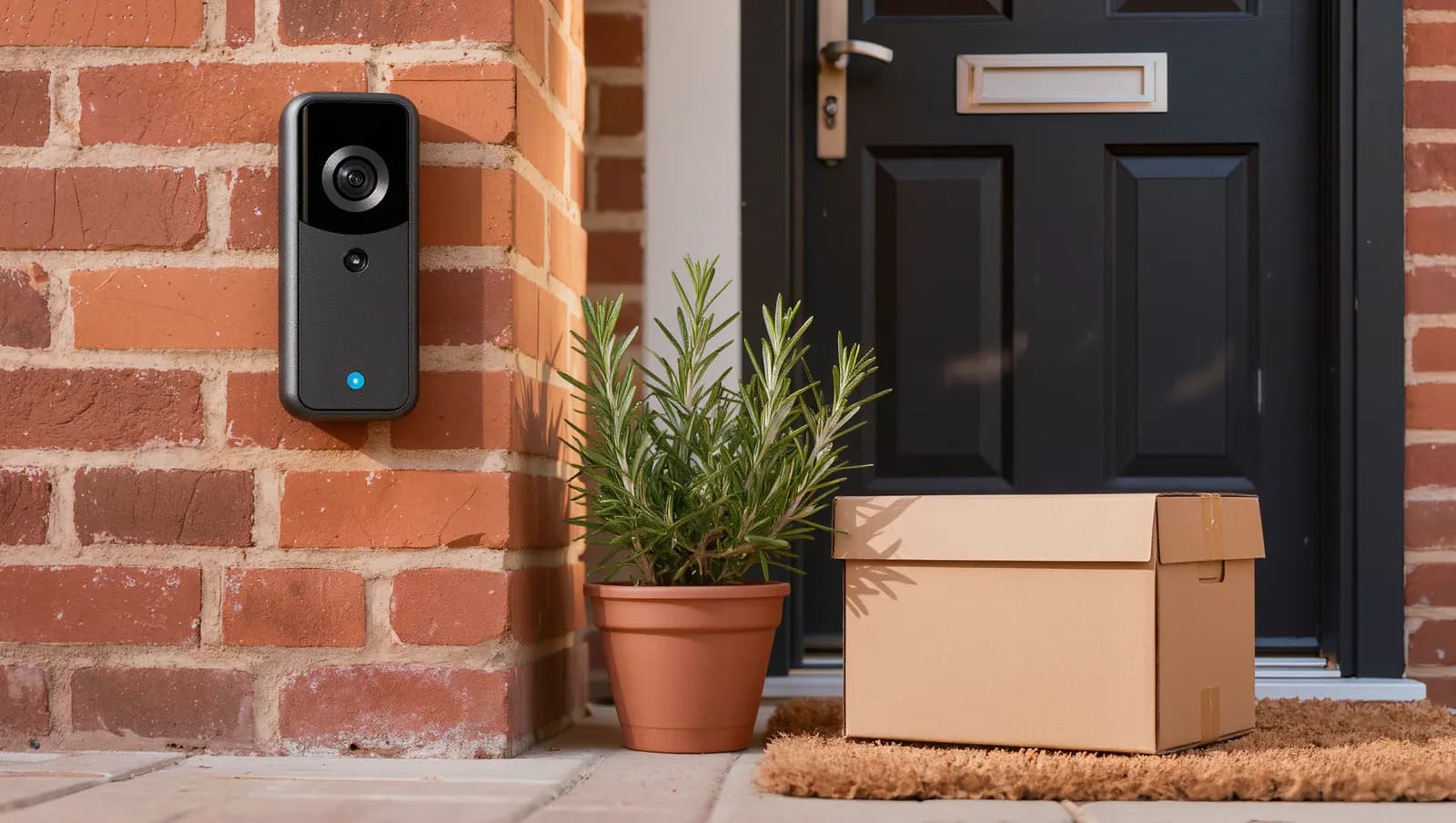
A video doorbell does two jobs. It tells you the moment a package arrives, which shrinks the window, and it records whoever walks up next, which gives police, the carrier, and the seller something to work with. Set the motion zone to cover the step where packages actually land, not the street, or you will get a notification for every passing car.
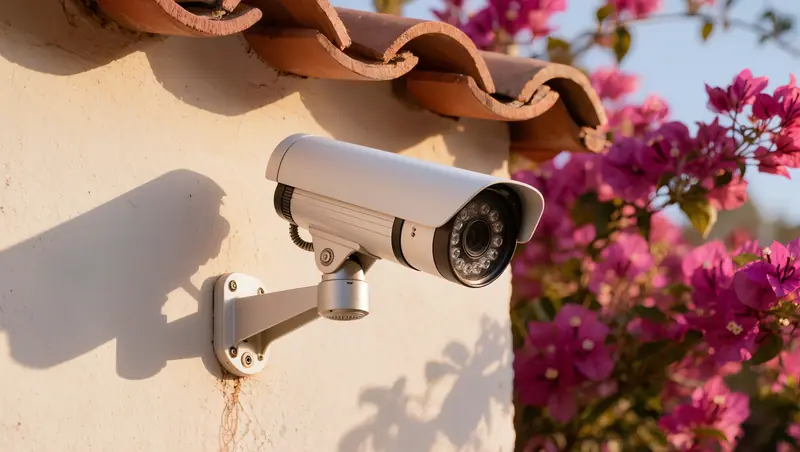
One doorbell camera sees one angle. Pair it with a camera that covers the driveway and the approach, and you capture the vehicle and the plate, which is usually the detail that matters. Our security cameras are placed after we stand where a thief would stand, not where the wiring is convenient.
Video works best inside a system. With smart home automation, a porch alert can turn on lights or let you speak through the doorbell to a driver or a stranger. Most people who walk up to take something are not hoping for a conversation.
If Your Package Is Already Gone
Act quickly and in order. Save the video before your camera’s storage cycles over it. Report the theft to police, since a report number is what sellers, carriers, and card issuers usually ask for, and under Section 31.20 the number of addresses a thief hits matters to the charge. Then contact the seller and the carrier, and your card issuer if the seller won’t help.
Tell your neighbors, too. Package thieves rarely stop at one door, and a neighbor’s camera may have caught what yours missed. While you are comparing notes, it is worth reading our guide to vehicle burglary and catalytic converter theft, since the same quick, low-risk mindset drives both crimes.
Straight answers
Questions readers ask
Is stealing a package from a porch a specific crime in Texas?
What is the penalty for mail theft in Texas?
What changed in the Texas mail theft law in 2025?
Do video doorbells stop package theft?
What should I do first if a package is stolen?
Sources & methodology
Figures are the most recent we could verify from the publishers below, checked October 2026. Where an official agency publishes nothing more recent, we say so rather than estimate.
- 1.H.B. No. 37, 86th Legislature: relating to the creation of the criminal offense of mail theft (enrolled) — Texas Legislature Online, 2019
- 2.S.B. No. 1281, 89th Legislature (enrolled) — Texas Legislature Online, 2025
- 3.Texas Penal Code Section 31.20, Mail Theft — Justia, 2025
- 4.New Texas law targets rising mail theft — KPRC 2 Click2Houston, 2025
- 5.Bankers celebrate new law to combat mail-related financial crimes — Texas Bankers Association, 2025
- 6.Porch pirates in Texas could now end up in prison — ABC News 4 (Sinclair national desk), 2019